
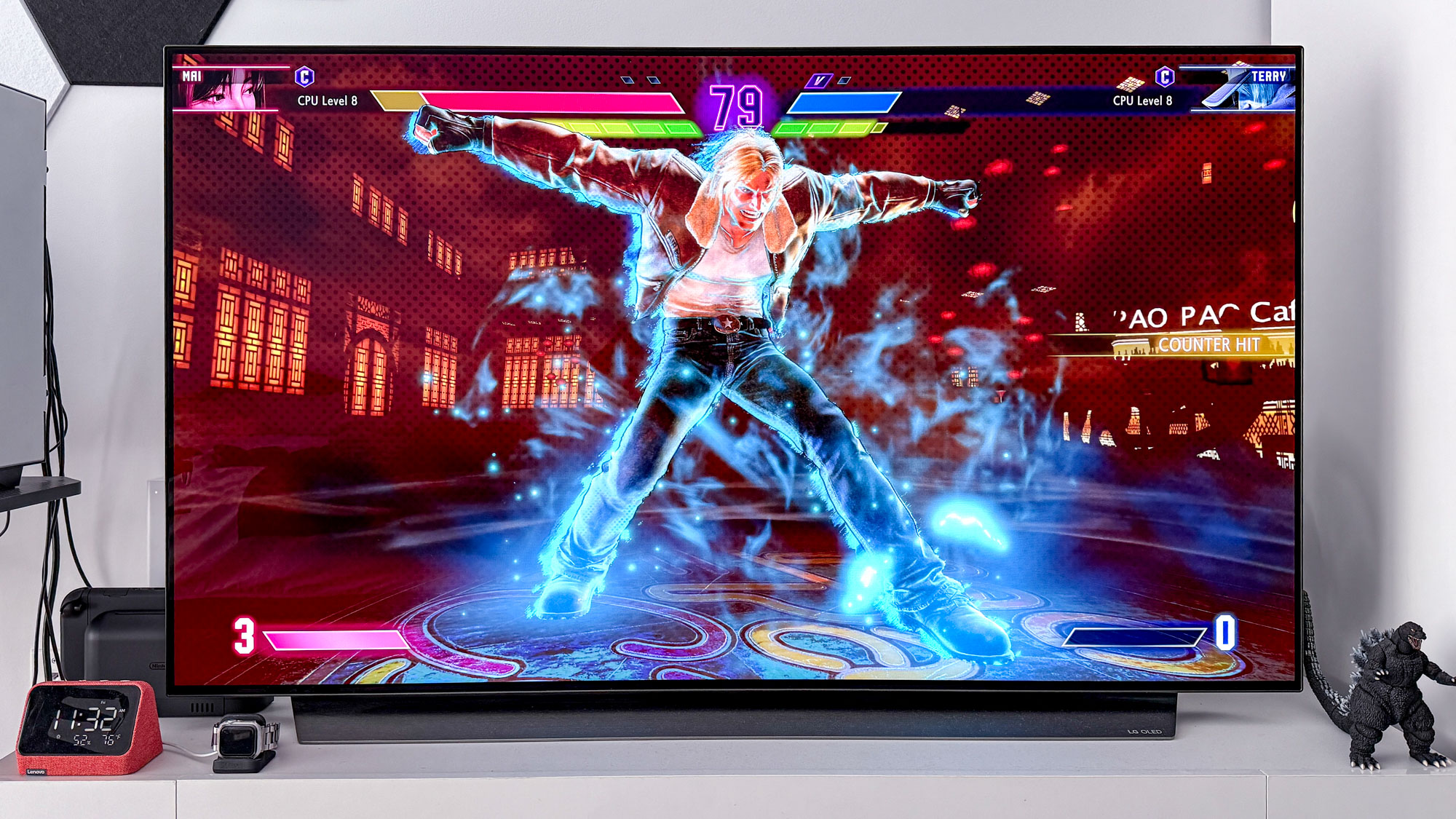
I’ve been immersed in gaming for most of my life, and my gaming habits have overwhelmingly revolved around a television screen. Even now, while I delve into the world of reviewing high-end gaming monitors, I find myself sticking with my trusty LG OLED. These monitors are undoubtedly engineered to deliver peak performance—high resolutions, rapid refresh rates, and minimal response times—but when it comes to my gaming preference, my TV still holds the top spot.
That’s not to say I haven’t been tempted. With gaming monitors like the Alienware AW3425DW, LG UltraGear 32GS95UE-B, and Samsung Odyssey OLED G9 showcasing exceptional capabilities, the lure is certainly strong. Yet, despite their alluring specs and improved performance metrics, I find myself hesitant to make the shift from my beloved TV to a monitor setup exclusively for gaming.
Currently, I’m enjoying my 55-inch LG CX OLED TV, which I purchased back in 2020 with my PlayStation 5 and high-end PC games in mind. While there are indeed superior models available, like the LG C5, my older model still checks all the boxes for what I need: an OLED display, HDR10 support, 4K resolution, a 120Hz refresh rate, HDMI 2.1 compatibility, and a lightning-fast 1ms response time in gaming mode. Given that I typically upgrade my television at the onset of new console generations, I plan on hanging onto this one until the arrival of the PS6.
My intention with this article isn’t to convert anyone; if gaming on a monitor is your thing, then you’re likely reaping the benefits of that setup. However, if you enjoy the TV experience as much as I do, just know that you’re not alone. Here’s a closer look at why I choose to game on my LG OLED TV.
**Optimal Aspect Ratio**
Once upon a time, large gaming monitors over 34 inches were a rarity, but not anymore, with options like the 45-inch LG UltraGear 45GX950A-B and the even larger 57-inch Samsung Odyssey Neo G9 becoming more commonplace. That said, many of these monitors feature curved displays and ultrawide aspects, which are amazing for immersion and productivity, but they don’t always cater well to every gaming experience.
One key drawback of ultrawide gaming monitors is that not every game, particularly those on console, supports these wider aspect ratios. For instance, many PS5 titles typically utilize a 16:9 format. This means, when connected to a 32:9 monitor, you’re often left with empty space at the sides. This limitation also extends to a majority of video content. While there are select games that fully embrace ultrawide proportions, I’m not convinced they provide the best overall experience for all that I play.
Having chosen my TV primarily for gaming, I appreciate the familiar 16:9 aspect ratio and flat panel. It suits the needs of most games and video content seamlessly, making it a practical choice for my gaming habits.
**Audio Quality**
In my experience, most gaming monitors lack built-in speakers, and when they do, the audio quality leaves a lot to be desired. Typically, this means relying on a quality headset for sound.
Personally, while I do own a few headsets, I reserve them mainly for voice-chat sessions with friends. Most of the time, I prefer the sound coming from my TV’s speakers. Yes, I acknowledge headsets can enhance sound quality and immersion, but I do not relish wearing them for extended periods. Since I’m not particularly discerning in terms of audio quality, using my TV’s speakers works just fine for me. If I transitioned to a gaming monitor, relying solely on headphones would become a necessity, which I’m not keen on doing.
And for anyone considering it, I don’t use a soundbar due to living in an apartment; I wish to be considerate to my neighbors. No matter how much I crank my TV’s volume, it simply won’t compete with a dedicated soundbar setup.
**Console Experience**
I began my gaming journey primarily through consoles, starting with the original NES right up to the PS4. The comfort of sitting in front of a TV, controller in hand, is synonymous with gaming for me. So when I transitioned to PC gaming about a decade ago, mirroring that same console experience was essential.
Currently, both my gaming and work PCs are connected to my LG CX. When the urge to play a PC game strikes, I simply select my TV as the output, boot up the game, and use one of the top-rated PC game controllers. Though it involves more steps than firing up my PS5 or Nintendo Switch, the essence of playing remains intact.
You might wonder how I deal with genres like RTS or MMORPGs, which typically require a keyboard and mouse. The answer is simple—I don’t delve into those genres. My roots lie in console gaming, and titles that demand mouse-and-keyboard precision, although fascinating, feel foreign to me.
If I could only enjoy PC games while seated at my desk, I wouldn’t identify as a PC gamer. I’ll elaborate on that later, but for now, the idea of gaming should align with how I’ve always enjoyed it: on my TV, just like a console experience.
**Not a Competitive Gamer**
For those in the competitive gaming scene, a gaming monitor is indispensable. The benefits of higher refresh rates and diminished response times are crucial for smooth gameplay and eliminating input lag. Take, for example, monitors like the Alienware AW2524H, reaching a staggering 500Hz refresh rate and a sub-1ms response time, a feat televisions simply can’t match.
While high refresh rates offer significant advantages in gameplay, the average gamer may not even notice these minute differences.
I’m not disputing that the prowess of a 240Hz monitor over a 0.03ms one makes a difference in some scenarios. If you’re a professional gamer, you might well discern the nuances between various refresh rates. That’s great for you, but as an everyday gamer, I simply don’t feel the need for the high performance a gaming monitor promises.
**Desire for Separation**
This final point encapsulates my overall preference for gaming on a TV. It’s a sentiment I share with many fellow gamers and friends. After spending the better part of my day working at a desk, the last thing I want is to remain at my workspace for gaming.
Living in a compact studio apartment, creating distinct spaces—no matter how artificially—is vital. Sure, moving just a few feet from my desk to my TV may seem trivial, but it mentally signifies the transition from work to relaxation. If I stayed seated at my desk to game, it would still feel like I was working, which can draw its own set of discomforts.
Sitting approximately eight feet away from my TV allows for a comfortable viewing experience without eye strain. In contrast, my work monitor is only an arm’s length away, and while I manage just fine during my eight-hour shifts, the prospect of further screen fatigue from gaming in that same spot is less than appealing. There are likely solutions to mitigate such strain, yet why go through the hassle when a simple shift to my TV brings a refreshing change?
**In Conclusion**
While gaming monitors undoubtedly provide an exceptional gaming experience—crafted specifically with that purpose in mind—as a reviewer, I still find myself returning to my LG OLED. It meets all my gaming needs and offers the added advantage of creating a healthy separation from my work environment. For now, I’m content to game as I always have—right in front of my TV.
 Priyam Gera