
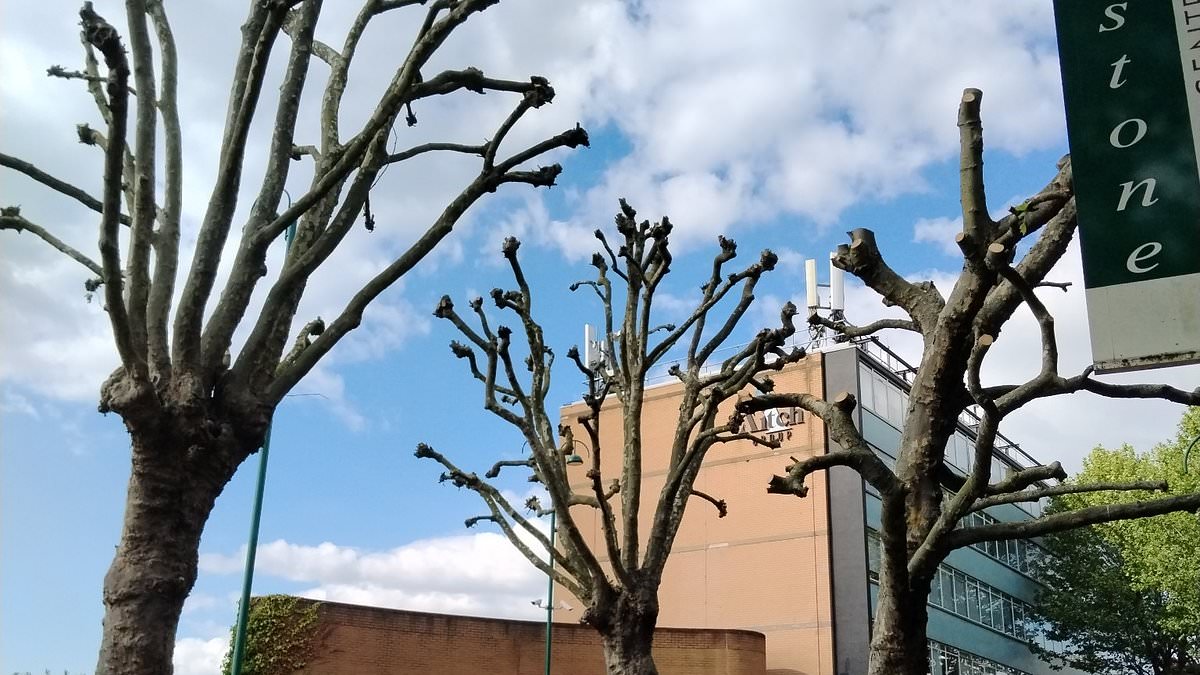
A contentious tree pruning initiative has ignited a heated debate in Waltham Forest, with frustrated residents accusing the local council of executing what they deem to be ‘brutal and inexplicable’ cuts to tree branches.
In an effort dubbed pollarding, Waltham Forest Council is undertaking the trimming of leaves and branches from various trees, aiming to uphold their health and encourage growth. However, this action has sparked outrage among locals, who claim that the streets are now cluttered with unsightly ‘bare stumps’, and many express concerns about the absence of shade during sweltering summer months.
Local resident Emma Woodcock voiced her discontent, describing the decision as ‘unnecessary.’ In her heartfelt commentary to the Local Democracy Reporting Service, she stated, “It just feels really brutal and unnecessary. Looking at a tree gives me a sense of joy. Looking at a stumpy old branch is fine in winter.”
Adding to the grievances, Ms. Woodcock pointed out that residents were not consulted by their local representatives before making such a significant decision.
In the same vein, Melissa Nisbett, who resides in the vicinity, labeled the act of pruning trees amidst a heatwave as both ‘inexplicable’ and ‘pretty appalling.’ This past spring broke records as the hottest in England, coupled with an astonishingly dry season that stretched over a century.
These extreme weather patterns transitioned into an equally scorching June, featuring two more heatwaves in the latter part of the month and extending into July. Ms. Nisbett argued that such council work should ideally have occurred during the winter months to prevent ‘direct hot sunlight’ from invading residents’ homes. She asserted, “The community should have access to shade and somewhere to stand waiting for a bus or sit under in a park.”
Additionally, she expressed worries about how these pruning practices could negatively affect tree health. The Royal Horticultural Society (RHS), the UK’s foremost gardening charity, recommends that pollarding should take place in late winter, considering autumn the least favorable time due to risks of decay fungi taking hold in the cuts.
While summer pruning can occur, the warmer temperatures and prolonged heat exposure may hinder regrowth and heighten the chance of disease. In severe cases, trees might even face the risk of death. The RHS warns that new growth during these months can be poor due to factors such as scorch, drought, or shading from surrounding trees.
Victoria Dove, a local allotment keeper, remarked that the now ‘bald’ trees undermine the considerable efforts residents have made to nurture wildlife within the community.
Nevertheless, Waltham Forest Council stands firm in its assertion that the pruning is contributing positively to the existing 55,000 trees in the borough. They emphasize that the pollarding efforts comply with the Countryside and Wildlife Act of 1981, which strives to safeguard wildlife that may be affected, particularly nesting birds.
Clyde Loakes, the Deputy Leader and Cabinet Member for Climate and Air Quality, emphasized that the council shares the community’s affection for trees and recognizes the myriad benefits they provide for both residents and wildlife. “While pruning, which we conduct every four years where deemed necessary, may result in a temporary loss of shade and habitat, it is crucial for maintaining the tree’s safety and promoting growth,” Loakes stated.
He also clarified that contrary to popular belief, this act does not prohibit tree work during certain months but rather imposes additional stringent criteria and responsibilities on those performing the jobs, including checks for active nesting birds and other wildlife.
Cllr Loakes reassured residents that no work would proceed if a nest is discovered in a tree.
A similar situation arose last year in Henley-in-Arden, Warwickshire, when a line of historic trees was abruptly severed, leading residents to accuse the Warwickshire County Council of vandalism and lamenting the destruction of their beloved landmarks. Locals feared the loss might deter tourists, questioning, “Who wants to take a selfie next to an ugly stump?”
The local authority emphasized that their decision followed reports from residents and businesses regarding the trees infringing upon buildings and hanging too low over the footpath. In a statement, the council explained that typically, tree cutting occurs later in the year as part of routine pollarding, but due to budget constraints, they chose to proceed immediately rather than conduct ‘remedial pruning works.’
Local business owner Amy Graham, 45, who operates a florist in the town, expressed disappointment, saying, “Everyone was gutted when they saw the trees had been hacked down to their stumps. We all understand the need for pruning, but this was extreme and apparently done to save a few quid because the council didn’t want to pay to have it done now and then again in the winter.”
Warwickshire County Council clarified that the trees had been pollarded, a process involving the removal of upper branches to stimulate a fuller, denser growth of foliage and branches.
 Priyam Gera