
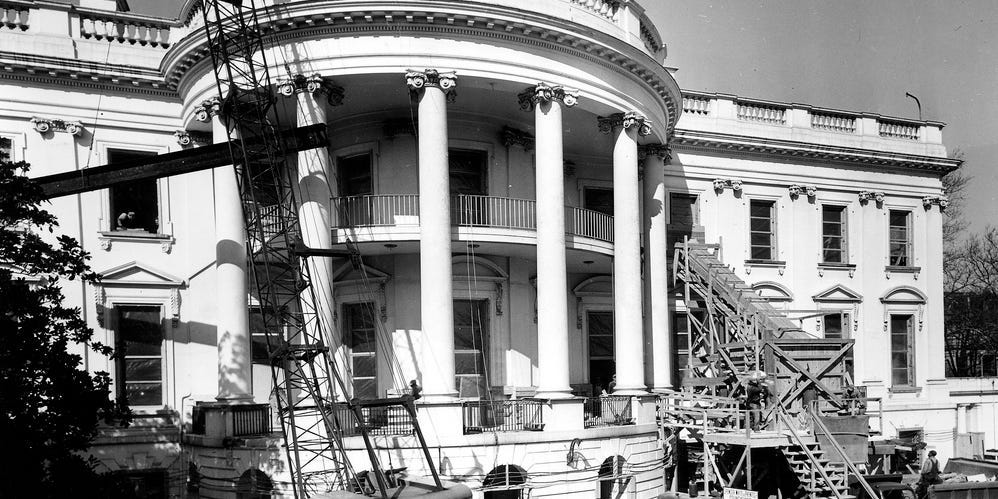
When President Harry Truman began his second term, the iconic White House was in a state of disrepair.
The East Room’s floor sagged a staggering 18 inches, while the president’s bathtub tilted into the foundation beneath it. The structural integrity of the building was compromised, unable to support the additional third floor and steel roof that were hastily constructed in 1927.
In 1948, the Truman family had no choice but to relocate to the nearby Blair House, the president’s official guest residence, as the White House embarked on a substantial four-year renovation project that racked up a bill of approximately $5.7 million, as reported by the White House Historical Association.
Fast forward over seven decades, and we’re witnessing yet another significant renovation at the White House. On a recent Tuesday, demolition efforts commenced on the facade of the East Wing to pave the way for President Donald Trump’s ambitious plan for a $200 million ballroom.
Aiming to accommodate 650 guests, this new ballroom is set to provide a more spacious alternative to the East Room, which has a capacity of just 200.
The White House described this new ballroom as “a bold, necessary addition that echoes the storied history of improvements and additions made by commanders-in-chief, ensuring that the executive residence remains a shining symbol of American excellence.”
Historical photographs capturing the Truman-era renovations, taken by National Park Service photographer Abbie Rowe and preserved by the US National Archives, reveal the extensive scale of the undertaking.
Rowe documented the White House renovations in 1950 when the project was only halfway completed.
At that time, the total costs of the renovation stood at $5.7 million, equivalent to about $76.4 million when adjusted for inflation as we approach 2025.
To bolster the structure, 126 new concrete support columns were crafted, digging down to depths of an impressive 26 feet.
Workers outfitted the State Dining Room with a new white oak floor, transforming the space into a more elegant setting.
Additionally, the main stairway of the White House was entirely rebuilt, showcasing the dedication to restoring its former glory.
Sunbeams filtered through the exposed beams that once separated a bedroom from a sitting room, creating a fascinating glimpse into the renovation process.
The only remnant of what was once the second-floor corridor was a delicately arched door frame, standing resolute amid alterations.
During this period of transformation, hints of the East Room’s former elegance lingered as visible remnants of the fireplace were uncovered.
And finally, as we take a look at the second-floor oval study above the Blue Room in 1950, we’re reminded of how deep the history of the White House runs.
A similar sense of transition filled the air on Tuesday as work progressed outside the East Wing, making way for Trump’s striking new ballroom.
(Note: This article was initially published in March 2013 and has been updated in October 2025.)
 Priyam Gera