
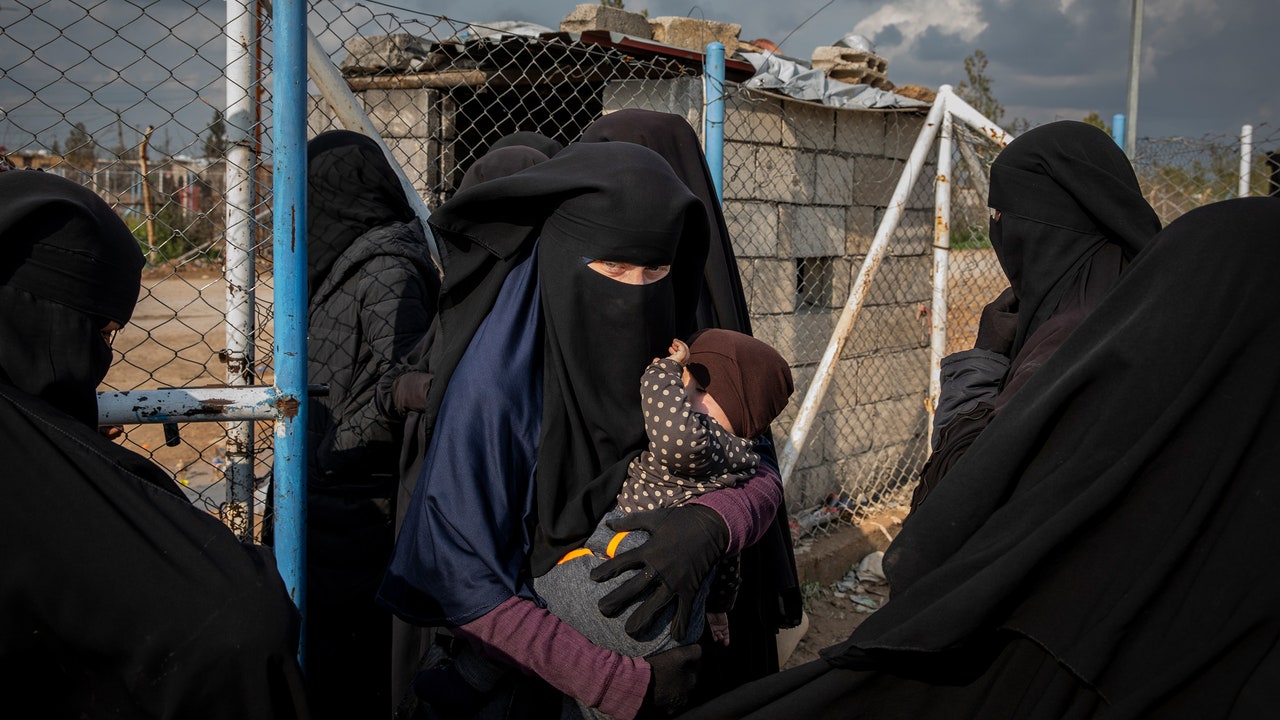
In 2012, Jihan and Mahmoud crept back to their home, reduced to ashes. Everything they owned, including their identification papers, had burned. To escape the advancing front line, the couple fled deeper into the caliphate. But nowhere was truly safe; one day, they witnessed an airstrike destroying the village they were staying in. Shrapnel barely missed them, chopping a nearby tree in half. Mahmoud carried Jihan to the car, and they raced off.
There was no choice but to escape the caliphate. They joined hundreds of other families trekking through the desert, many paying smugglers to help them evade ISIS checkpoints. The caravan moved northwest toward Raqqa, and finally reached a checkpoint of the U.S.-backed Kurdish forces. The travelers, comprising sick, wounded, pregnant, and dying people, begged the soldiers to take them in. The soldiers demanded identification documents, which Jihan and Mahmoud no longer had. Only a small number were admitted, most were loaded onto cargo trucks. Jihan, who hadn’t eaten in days, was barely conscious. After many hours, they were unloaded under the floodlights, informed that their new home was Al-Hol.
In 2006, the Syrian government settled a few hundred Palestinian refugee families on a dusty, scorpion-infested stretch of brushland near the Iraqi border. The Palestinian families had been living in Iraq, and had fled the violence unleashed by the U.S. occupation; they had already been expelled from their ancestral lands by Israel in 1948. The U.N. built cinder-block houses for the refugees. During the Syrian civil war, the camp filled with more displaced families. When the caliphate fell in March, 2019, thousands of its residents were corralled into Al-Hol, and the camp was abruptly converted into one of the world’s largest prisons.
Today, Al-Hol’s fifty thousand residents are grouped into sectors separated by barbed wire; it takes half an hour to walk from one sector to the next. Most sectors hold Syrians and Iraqis, but the “Annex” is home to about six thousand Europeans, Asians, and Africans, some of whom have been denied repatriation by their home governments. Horticulture is evident here and there around the camp, with squash and bean plants peeking over tents. A few non-governmental organizations operate health clinics, but inmates complain that malnutrition and water-borne disease are pervasive. Crowds jostle around bathrooms with clogged pipes. Most inmates receive money from relatives, and the informal cash-transfer system allows them to buy smuggled goods, including drugs. The souk, built by inmates, offers small grocers, carts selling makeup, and smoothie stands. A few lucky prisoners own shops, but most stalls are run by outsiders with permits to enter the camp. A mass of black-clad women drifts among the stalls, examining bras, haggling over cigarettes. You can guess who the true believers are: the women who cover not only their faces but also their eyes tend to be loyal to ISIS.
When Jihan and Mahmoud arrived at their assigned tent, Jihan encountered many detainees with stories like hers. The common denominator was guilt by association. There was a woman named Fatima, from central Syria, whose husband had joined the protests, then ended up in ISIS. Her family insisted that she divorce him, but they had a child, and according to local custom, custody goes to the father. Fatima disagreed, and was therefore disowned. Eventually, her husband died in battle, and Fatima was transferred against her will to a guest house for ISIS widows. She refused ISIS suitors, wanting to be reunited with her family. During America’s bombing campaign, she was moved from village to village by ISIS, and ended up living in a ditch as ordnance exploded around her. Now she and her child were in Al-Hol, surviving on camp rations, as she waited for a sign from her family. She hadn’t spoken to them in four years.
“Ah, I see you’re trying to vent. May I offer you some annoyingly pragmatic solutions?” Cartoon by Sarah Akinterinwa
 Priyam Gera