
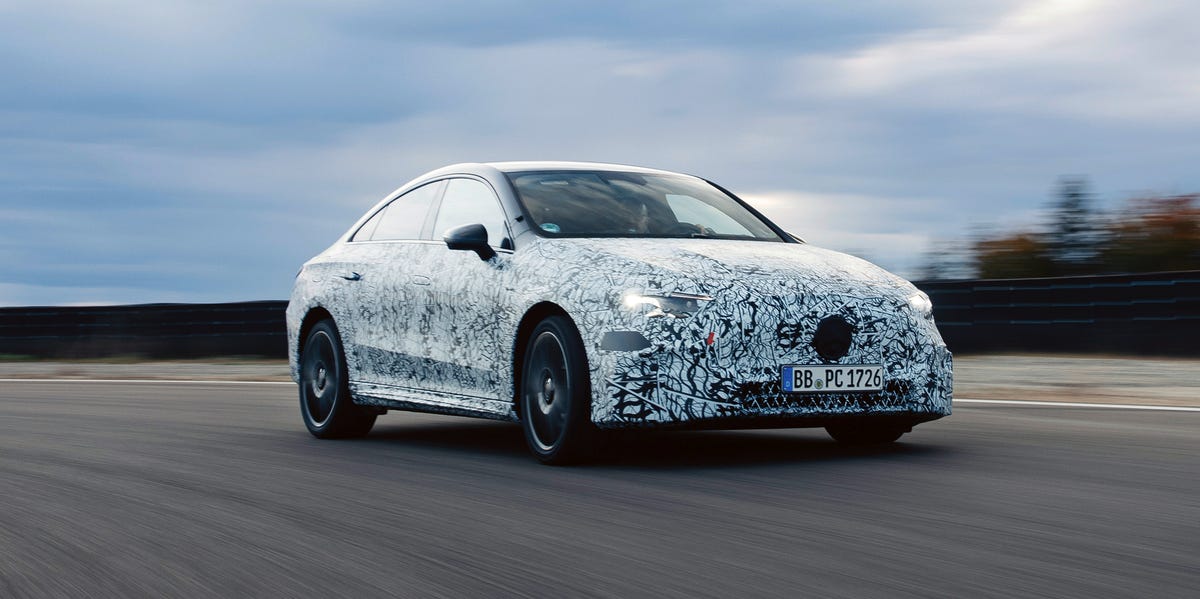
Perhaps you’ve been among the many critics questioning the entire Mercedes-EQ approach, particularly with its unconventional naming scheme and the unusual egg-shaped design. If that’s the case, you may find a sense of vindication in the automaker’s recent shift back toward a more traditional lineup.
A series of new product announcements indicate that Mercedes is steering away from the EQ-specific design language, opting instead to merge various powertrains under a cohesive aesthetic. The first signs of this renewed direction are evident in the G-Class: the G550 features a gas engine, while its visually identical counterpart, the G580, is fully electric. This evolving approach will also be reflected in the upcoming CLA-Class.
Having already had an early look at the forthcoming electric CLA, it’s time to take the CLA hybrid for a test drive.
Not Your Average Hybrid
In the world of Car and Driver, we tend not to categorize “mild hybrids” separately from their more traditional siblings. Yes, these so-called mild hybrids come equipped with electric motors and batteries (albeit quite small), but their 48-volt systems primarily serve to facilitate engine-off coasting and prolong stop-start functionality. They are far from the likes of a Toyota Prius.
The CLA hybrid, while still a 48-volt model, stands out enough to justify our cohesive classification. It features a new 1.5-liter four-cylinder engine, known as M252, which operates on the more efficient Miller cycle. This works in conjunction with a 1.3-kWh lithium-ion battery and a 27-hp electric motor integrated within an eight-speed dual-clutch automatic transmission. Altogether, the CLA hybrid is expected to deliver roughly 188 horsepower.
So, what distinguishes the CLA hybrid from its peers? Simply put, it aims higher than a typical “mild hybrid.” Standard 48-volt hybrids usually glean a bit of energy from braking, but the CLA can channel up to 25 kilowatts of energy back into the system at any moment. The design of the brake pedal is also noteworthy; it comprises an integrated module that generally does not offer a mechanical link between your foot and the brakes. Instead, the pedal’s force and travel—as well as the braking actions—are managed electronically, though hydraulic backup is available if necessary. This innovative module aims to maximize regenerative braking efficiency, engaging friction brakes only when absolutely required.
Mercedes claims that the CLA hybrid will function on electric power alone in short bursts, but don’t expect to cruise 10 miles solely on battery—unless you’re coasting downhill. It will enable EV operation in stop-and-go traffic or on the way out of your neighborhood, but not much beyond that.
Driving the CLA Hybrid
Our experience with the CLA was limited to pre-production prototypes which we tested under the same cold-weather conditions faced by the engineers during the car’s development phase. Our journey commenced atop a snow-laden Swedish mountain, navigating rutted roads shrouded in ice.
With standard non-studded winter tires, the CLA maintained its composure during the descent—until a sharp turn led to a delightful drift. Engaging Sport mode grants a bit more leeway, but regardless of the setting, the electronic stability control rapidly intervened with minimal noise or vibration. It responded swiftly; by the time we made a corrective steering maneuver, the car was already well on its way to regaining stability.
Since the first stretch comprised entirely downhill terrain, the combustion engine remained inactive. Minor throttle inputs yielded just enough acceleration, yet achieving power-induced oversteer required a more assertive push on the gas, allowing the engine to join seamlessly, thanks to the e-motor’s dual role as the starter.
If your daily commute happens to be all downhill (quite the opposite of how your grandfather walked to school), you won’t hear much from the engine. This is acceptable; while the 1.5-liter Miller-cycle four sounds decent, it’s nothing extraordinary. The transition from electric motor to gas engine was essentially imperceptible—a commendable feature we must highlight, along with the new brake-pedal setup that offered a consistent, robust pedal feel without any awkward integration issues. This is particularly noteworthy for anyone who’s driven a Benz EQ model.
The latter part of our CLA adventure unfolded on a frozen lake at a Mercedes-Benz proving ground, where we engaged in a bit of spirited fun. Rest assured, the CLA excels at snowy donuts, a thrill that’s exhilarating, though perhaps not quite as instantaneously gratifying as in the all-electric variant.
Mercedes has achieved remarkable smoothness from its 48-volt hybrid system, demonstrating that this approach isn’t as peculiar as some might think.
 Priyam Gera